The Meeting Tool Stack Is Getting Out of Hand
The Meeting Tool Stack Is Getting Out of Hand
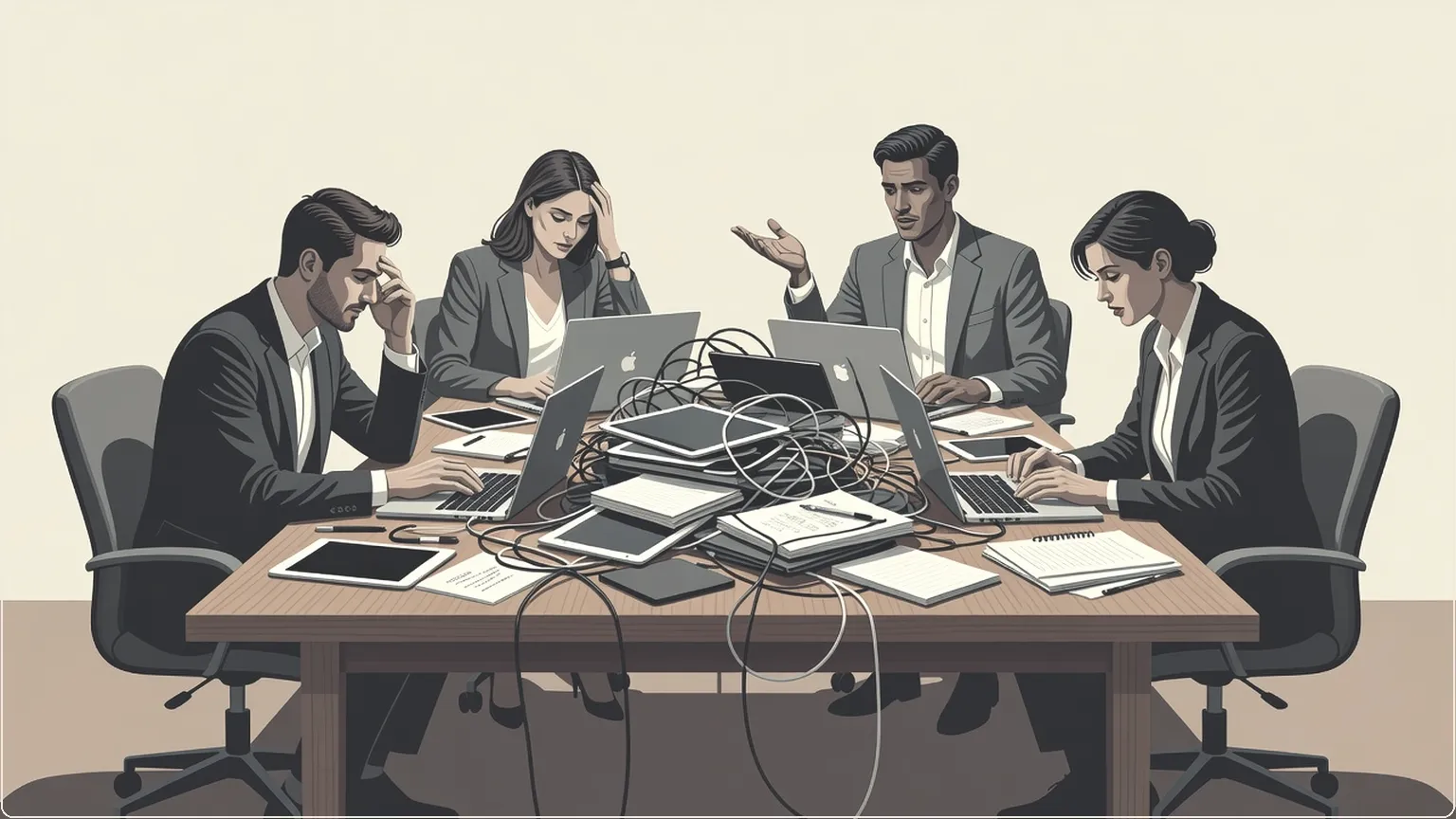
Otter, Fireflies, Fathom, and Granola each now own a different corner of the market — Fathom on generous free recording limits, Otter on searchable archives and live transcription, Fireflies on CRM integrations and 100+ language support, Granola on bot-free local capture with editable notes [4][5][6]. The result: most serious users aren't picking one tool, they're stacking two or three and piping the output through an LLM into Slack, Notion, or Salesforce.
X threads this week captured what one poster called the "beauty and brokenness" of this setup — powerful individually, chaotic in aggregate. Free tier limits vary wildly (Otter caps at 300 minutes/month; Fathom offers unlimited recording but only 5 AI summaries), which pushes power users toward improvised orchestration rather than a single trusted source of truth.
This fragmentation is the real story beneath the feature wars: nobody has yet built the layer that unifies transcripts from five different tools into one coherent, queryable memory. That gap is exactly where the market is heading next.
Second Brains and Knowledge Graphs Move From Niche to Mainstream
Obsidian, Notion AI, Mem, Reflect, and Tana are all leaning harder into knowledge graphs in 2026 — bidirectional links, visual mapping, and AI retrieval layered over personal notes and conversations [7][8][9]. The pitch has shifted from "better notes" to "structured data that reduces hallucinations," with enterprise teams increasingly treating these graphs as agentic-accessible memory rather than static archives.
On X, the enthusiasm is concentrated around NotebookLM-style prompting and Obsidian plugins that convert raw meeting transcripts into persistent, linked knowledge rather than another dead folder of text. The throughline across these tools is permanence: notes that compound in value over time instead of being read once and forgotten.
RAG Architecture Gets Serious About Precision
Technical guides published this year now catalog at least eight distinct RAG patterns — naive, hybrid (dense + BM25), GraphRAG, agentic, rerank, adaptive, multimodal, and memory RAG — with agentic RAG emerging as the likely default for complex enterprise retrieval [10][11][12]. Best practice has moved decisively toward hybrid search with rerankers like Cohere, better chunking, and query transformation, all aimed squarely at cutting hallucinations.
Developer threads on X are increasingly specific about applying this to conversation-derived knowledge bases — i.e., meeting transcripts — rather than static documents, which is a meaningfully harder retrieval problem given speaker context, temporal drift, and cross-meeting references.
What This Means For Your Meetings
Today's news traces one clear arc: transcription is becoming table stakes, and the real competition is shifting to what happens after the meeting ends. Wispr Flow's launch and the Otter/Fireflies/Fathom/Granola stacking problem are two sides of the same coin — capturing a meeting is now easy and often free, but turning weeks or years of meetings into something you can actually query, trust, and act on is still unsolved for most teams.
That's precisely why knowledge graphs and advanced RAG are showing up in the same news cycle as notetaking apps. A transcript sitting in a folder is not knowledge — it's raw material. The tools winning attention right now (GraphRAG, agentic retrieval, structured second-brain graphs) are all attacking the same problem: making retrieval precise enough that professionals trust the answer instead of re-watching the recording. This is exactly the terrain where speaker-aware, graph-structured transcription — built once and queried across your entire meeting history rather than tool-by-tool — has a structural advantage over stacking point solutions.
The fragmented-stack complaints on X aren't a minor annoyance; they're a market signal. Professionals don't want five silos of meeting data with five different query interfaces — they want one coherent memory that spans every conversation they've ever had, retrievable with the precision that modern RAG now makes possible.
Key takeaway: The meeting AI race is over for transcription — it's commoditized. The next battleground is durable, structured, cross-meeting knowledge you can actually query with confidence, and that's where the real value will concentrate in the next 12 months.
Sources
- https://wisprflow.ai/whats-new
- https://wisprflow.ai/notetaker
- https://www.producthunt.com/products/wisprflow
- https://www.granola.ai/blog/meeting-note-tool-pricing-granola-vs-fireflies-fathom-otter
- https://www.itsconvo.com/blog/otter-vs-fireflies-vs-fathom
- https://meetingnotes.com/blog/best-ai-note-takers
- https://tana.inc/blog/best-second-brain-apps-2026
- https://www.taskade.com/blog/ai-second-brain-tools
- https://www.atlasworkspace.ai/blog/best-second-brain-apps
- https://aithinkerlab.com/build-rag-systems-2026-architecture-patterns/
- https://medium.com/@angelosorte1/rag-architectures-every-ai-developer-must-know-in-2026-a-complete-guide-with-examples-ea59471aeb01
- https://www.linkedin.com/pulse/complete-2026-guide-modern-rag-architectures-how-retrieval-pathan-rx1nf
Get the daily briefing
AI, knowledge graphs, and the future of work — in your inbox every morning.
No spam. Unsubscribe anytime.